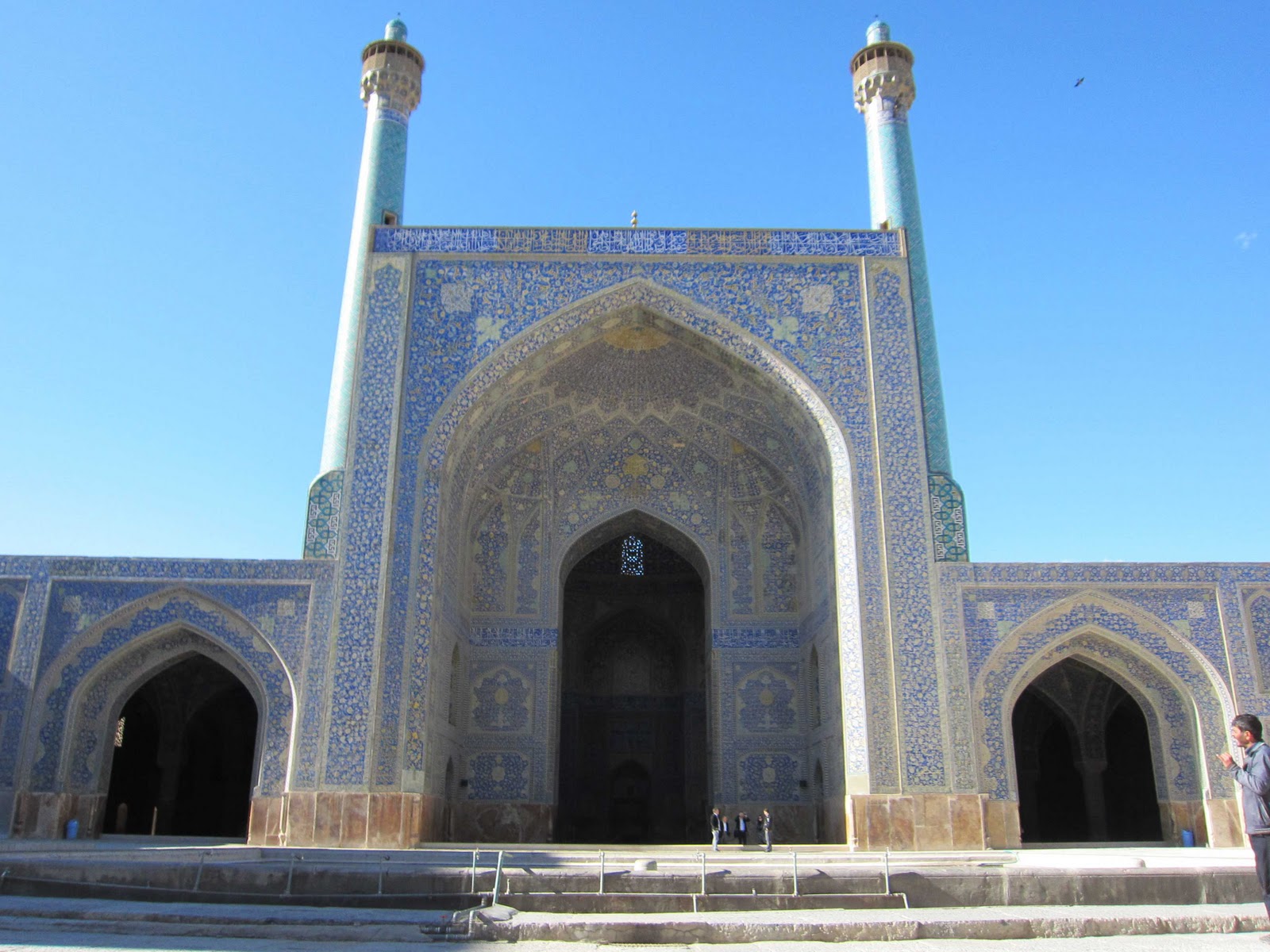
I know I promised to make all of my posts bitesized, but I have to conclude my Iran writings before the impressions wane, and Thailand's vivacious street culture overlays my memories. I hope you forgive me that this time it's a bit longer.
Safety
I hope my last post gave a rough idea why I would go to Iran. But many people asked me questions such as: "Isn't that dangerous?" or "Can you go in there?", so I want to dispel some of your doubts.
The commonly propagated picture of Iran in western media is that it is a semi-terrorist state, full of religious nutcases, djihadist militia and and roaming bandits (with nuclear weapons). Obviously such a country must be dangerous to tourists and impossible to get in. Not so.
In fact, getting into Iran is very easy, if somewhat expensive. If even American proselytizers can make it, you can, too. You have to get a number from a certified Iranian travel agency (there's many), which enables you to get a visa. The whole process costs between 70 and 90 pounds, which will give you an extendable 15 day visa. If you travel with a group, all of that will be included in your tout price. Denial of visa is exceptionally rare.
Usually the visa can be extended by 30 days at any immigration office, and is rarely denied (I met several people who extended four or five times), unless you have caught some unwanted attention.
As far as public safety goes, Iran is a very safe country. The amount of crime is low, and as a tourist you will have little more to fear than touts and the occasional pick pocket (which you get in any country anyway). Unless you are asking for it (like traveling the Pakistan border regions or engage in illegal activities) you will have nothing to fear even if you follow one of the many friendly strangers' invites to their homes.
Culture and Religion
While we Europeans generally tend to think of Iran as "just another Muslim middle eastern Arab something state", Iran's culture and self-conception is very different, and Iranians loathe to be thrown in with "the rest of the Middle East", and rightly so.
Iran has a very strong and extensive cultural heritage, and one that most Iranians are very aware of. Persia boast one of the oldest civilizations on Earth, with about 8000 years of continued cultural development, and some of this culture still rings true in the mind and soul of the Iranians, well throughout conquest and oppression. I won't go into any historic details here, but I want to give a few examples of what makes Iran different and why that is important in Iranian society today.
Firstly, and my Iranian friends insist I write this, Iranians are not Arabs. They are Aryans, quite different in appearance and historic background, with their own language and customs. The conquest of Persia by the Arabian tribes and subsequent conversion to Islam are perceived, despite the ensuing cultural developments, as an insult by many Iranians even today. Some even insist on using only "true" Persian words, greeting each other with "Dorud" instead of "Salam" (which is Arabic).
Zoroastrianism
Despite repeated conquest by Arabs and Mongols, colonization by European powers and political oppression, old Persian customs have persevered through time. Most of these customs date back to the times of Zoroaster, roughly 3000 years ago. While the religion itself is almost extinct (with about 120000 followers), its symbols and rituals are integral to Persian identity. The ethics of Zoroastrianism are simple: "Think good, speak good, act good', an ideal that is embodied in the symbol of Fravahar, found across Iran on old Temples and modern necklaces alike. For many Iranians with anti-government or anti-islamic sentiments it is also a nationalistic symbol of what they think is truly Iranian.
One of the Zoroastrian customs practiced by most Iranian is Noruz, the Persian festival of the new year. The date is set by a special Zoroastrian calendar (yes, that means that Iranians have to juggle three different dates each day), and consequently at a different time each year. It is celebrated with a "haft sin" party, where seven things starting with the letter "s" are gathered at a table, and visiting all family members, oldest first. Many Iranians also go on holiday during this season, a fact I had to learn by hard, as transport was difficult and hard to book.
Also Zoroastrian in origin is the fire festival, which involves jumping over lit fires to cleanse the soul. Both of these customs are discouraged by the government, even more so now, as the festivities are often used for protest gatherings.
Poetry
In times of youth, drinking is better.
With the joyful, linking is better.
The world is a mere temporal inn;
With the shipwrecked, sinking is better.
-Hafez (1325-1389)
One very endearing fact about Iran is that its great heroes are not generals or warriors, but Poets. The greatest, Hafez, Ferdosi, and Sa'di have elaborate Mausoleums that draw large crowds throughout the year, who pay respect and reference to their lives and great works. Hafez, especially popular, is often quoted and almost all Iranians can recite some of his poetry. So important his works are to the Iranian spirit that it is said that "every household should have two books: the Quran and Hafez". His works were enticing enough to prompt good old Goethe to translate them, and have been translated in dozens of languages. Hafez himself seemed to be a joyful fellow, with much of his poetry being about love and wine, with some melancholic intermezzos of the decay of youth. No wonder, he was living in Shiraz, once, but no longer, famed for its excellent wine and entertainment.
Islam
Islam has come to the Iranians by force, in the shape of the the Umarian Caliphate and its Arabian armies, but was rapidly accepted and soon became the dominant religion. Since the 15th century, Iran belongs to the Shia branch of Islam, and today, the vast majority of Iranians are Shiite Muslims (default by birth). The contributions of Iran to Islamic art and culture are manifold and impossible to recount, but I would like to focus more on what Islam, in my humble experience, means for the country and its Inhabitants today, as it is the most obvious and frequently mentioned Iranian trait.
Islam is not as consistently visible in the bigger cities as you might think. Sure, women wear a headscarves, but they could well be fashion accessories, and you only infrequently see chadors (the long black ones) and I have never seen a burka until I came to (ironically) Dubai.
The Hejab-o-Meter
Constant readjustment of the Hejab line has become a compulsive behavior for most women, though, and how much hair you shows both the persons mindset or the piety/repressiveness of the surroundings.To illustrate that, I have created a Hejab-o-meter, which roughly shows the connection between those parameters (thank you for lending your likeness, Samane):

Safety
I hope my last post gave a rough idea why I would go to Iran. But many people asked me questions such as: "Isn't that dangerous?" or "Can you go in there?", so I want to dispel some of your doubts.
The commonly propagated picture of Iran in western media is that it is a semi-terrorist state, full of religious nutcases, djihadist militia and and roaming bandits (with nuclear weapons). Obviously such a country must be dangerous to tourists and impossible to get in. Not so.
In fact, getting into Iran is very easy, if somewhat expensive. If even American proselytizers can make it, you can, too. You have to get a number from a certified Iranian travel agency (there's many), which enables you to get a visa. The whole process costs between 70 and 90 pounds, which will give you an extendable 15 day visa. If you travel with a group, all of that will be included in your tout price. Denial of visa is exceptionally rare.
Usually the visa can be extended by 30 days at any immigration office, and is rarely denied (I met several people who extended four or five times), unless you have caught some unwanted attention.
As far as public safety goes, Iran is a very safe country. The amount of crime is low, and as a tourist you will have little more to fear than touts and the occasional pick pocket (which you get in any country anyway). Unless you are asking for it (like traveling the Pakistan border regions or engage in illegal activities) you will have nothing to fear even if you follow one of the many friendly strangers' invites to their homes.
 |
| This is how dangerous Iran is. I barely made it. |
Culture and Religion
While we Europeans generally tend to think of Iran as "just another Muslim middle eastern Arab something state", Iran's culture and self-conception is very different, and Iranians loathe to be thrown in with "the rest of the Middle East", and rightly so.
Iran has a very strong and extensive cultural heritage, and one that most Iranians are very aware of. Persia boast one of the oldest civilizations on Earth, with about 8000 years of continued cultural development, and some of this culture still rings true in the mind and soul of the Iranians, well throughout conquest and oppression. I won't go into any historic details here, but I want to give a few examples of what makes Iran different and why that is important in Iranian society today.
Firstly, and my Iranian friends insist I write this, Iranians are not Arabs. They are Aryans, quite different in appearance and historic background, with their own language and customs. The conquest of Persia by the Arabian tribes and subsequent conversion to Islam are perceived, despite the ensuing cultural developments, as an insult by many Iranians even today. Some even insist on using only "true" Persian words, greeting each other with "Dorud" instead of "Salam" (which is Arabic).
Zoroastrianism
 |
| The sanctum of the Zoroastrian temple at Chak-Chak |
Despite repeated conquest by Arabs and Mongols, colonization by European powers and political oppression, old Persian customs have persevered through time. Most of these customs date back to the times of Zoroaster, roughly 3000 years ago. While the religion itself is almost extinct (with about 120000 followers), its symbols and rituals are integral to Persian identity. The ethics of Zoroastrianism are simple: "Think good, speak good, act good', an ideal that is embodied in the symbol of Fravahar, found across Iran on old Temples and modern necklaces alike. For many Iranians with anti-government or anti-islamic sentiments it is also a nationalistic symbol of what they think is truly Iranian.
 |
| The Fravahar Symbol |
Also Zoroastrian in origin is the fire festival, which involves jumping over lit fires to cleanse the soul. Both of these customs are discouraged by the government, even more so now, as the festivities are often used for protest gatherings.
 |
| A Haft Sin table, ready for Noruz |
In times of youth, drinking is better.
With the joyful, linking is better.
The world is a mere temporal inn;
With the shipwrecked, sinking is better.
-Hafez (1325-1389)
 |
| Thousands come to the tomb of Hafez every year |
Islam
 | |
| Unlike shopkeepers, Allah helpfully communicates with me in English. At least I am not lost for spiritual guidance. |
Islam is not as consistently visible in the bigger cities as you might think. Sure, women wear a headscarves, but they could well be fashion accessories, and you only infrequently see chadors (the long black ones) and I have never seen a burka until I came to (ironically) Dubai.
The Hejab-o-Meter
Constant readjustment of the Hejab line has become a compulsive behavior for most women, though, and how much hair you shows both the persons mindset or the piety/repressiveness of the surroundings.To illustrate that, I have created a Hejab-o-meter, which roughly shows the connection between those parameters (thank you for lending your likeness, Samane):
If you are unlucky, the moral police (also known as "Fati(ma)kommando") might fine you if your hejab is too far down. At home most women I encountered did not wear Hejab, and in their cars, sort of in between private and public, sexual segregation and hejab rules are somewhat relaxed. This leads to many girls walking around certain streets, hoping to find a boy's car to hop into to exchange phone numbers and have a good time, pretending to be relatives to the public,
There is some segregation in buses and cofeehouses, but most younger people ignore it, and little ever happens. Having a boy or girlfriend is not uncommon, and many of the couples on the street holding hands are not married. Virginity is still somewhat expected of a woman before marriage, and most girls abstain or practice non-vaginal sex.
People are telling me that enforcement of the islamic rules is getting worse, as police cracks down on more and more offences. There is a difference in which ones, though: Some years ago, an engineer told me, police used to fine people for having foreign pop music in the car, or for wearing sunglasses "the American way", and other slight moral faults. Nowadays, speaking to foreigners or having private gatherings are a much bigger affair. And it seems to me that this is the most important change in Iran before and after Ahmadinejad:
Before, repression was the means to achieve the goal of a moral Muslim state. Since Ahmadinejad, the order has reversed: Muslim moral standards are now the means of repression, and the goal is control. The dictatorship is a worldly one, and just like in communist dictatorships, the moral systems are no longer an objective, but just excuse for oppression. Like one of my Iranian friends put it: "Khomeini earnestly thought that Islam would help Iran. He was wrong, which can happen. But now the experiment has generated a Frankenstein state."
Recent surveys have shown that most people support Islam, but want politics and religion to be separate. It's to see if the sentiment translate into action, and if the government will crack down even more.
Conclusion
So. How was it? How do I feel? Is it worth going?
First of all, it was great. The people are very kind and sociable, the cultural heritage is amazing, and it's good value. Many of the sights are unique and definitely a must see (like the National Jewels and the architecture of Esfahan), and entry to them is cheap as chips (between 30 pence and 2 pounds). As discussed above, the country is safe, and as a tourist you will have little to fear.
I recommend going for anyone who is a culture vulture or a nature freak, but you might want to wait some years, as almost all major sights are currently under restoration. If you are a solo traveller, or looking for holiday fun, I can recommend Iran only with a grain of salt. Since alcohol, dancing and parties are forbidden (although they do exist), there is little base fun value to be found in Iran. If you like to meet people and are wary of you surroundings, Iran is a very rewarding destination for individual travellers. Some Farsi will help though.
Also, Iran has left me with a feeling of sadness. Having seen all its amazing heritage, with all its appreciation of beauty, it's poetry of love and wine, it's desire to socialize and be merry, to dance and sing, it pains me to find its population suppressed by a inhuman government, so much the opposite of the Iranians' true soul that I have found in its art and people. I truly hope that I see the day when these shackles are broken, and Iran returns to what it was once famous for: a country of sensuality and plenty.
 |
| A couple sharing wine |
 |
| Noruz celebration with music and dance |