Mittwoch, 9. März 2011

The Travelogue, Part VI - Germany: Fasnacht


Despite being the furthest away from being a grand exotic place, my hometown has something quite unique to offer: Fasnacht.

These are inspired by Austrian Krampus costumes
While carnival is celebrated in many countries (such as famously Venice and Brazil), Alemannian Fasnacht is much closer to its origins. Having its roots in pagan festivals to exorcise winter and herald the coming of spring, much of the ancient spirit has survived; unlike the carnivals in Rio de Janeiro or Cologne, the majority of costumes still draw their inspiration from the haunting and the sinister. With christianization these traditions had been canalized into something more palatable to the church, and Fasnacht became a fest to use up perishable foods before Lent, giving people time to indulge and celebrate before a time of hardship.


"Saubachgeischter" climb everything

Over the centuries, new influences have found their way into the traditional mixes, and style elements from the baroque era, Napoleonic times and modern periods have been added. Still today, new "Zuenfte" spring up every year or so, while the ones that are hundreds of years old still remain.

Zunft originally meant "guild", and they are pretty much run as such. All members wear the same costume every year, and usually have various gatherings throughout the year for marching band practice and general merriment (and the occasional business deal). Many regulations can surround memberships, such as that it can only be passed on to the eldest son, which makes affiliation with a Zunft quite a tradition-laden affair. The traditional costumes are all hand made and very expensive (especially the carved wooden masks) and can cost Zunft members several thousand euros.


Baroque style costumes
While Fasnacht starts officially on the 11th of November, the actual party happens in late February and lasts for about a week, during which the inner cities are filled with costumed revellers. Public drinking and pranks are openly encouraged, with many of the bigger companies handing out free beer and food. The Zuenfte march to the schools and tie down the teachers, officially releasing the students into carnival, who then join the street party in town. Fasnacht-Kisses are given to anyone who comes along, and needless to say, the week-long party often produces unexpected aftermaths in November.


Below are some snapshots and a video from the Sunday parade.


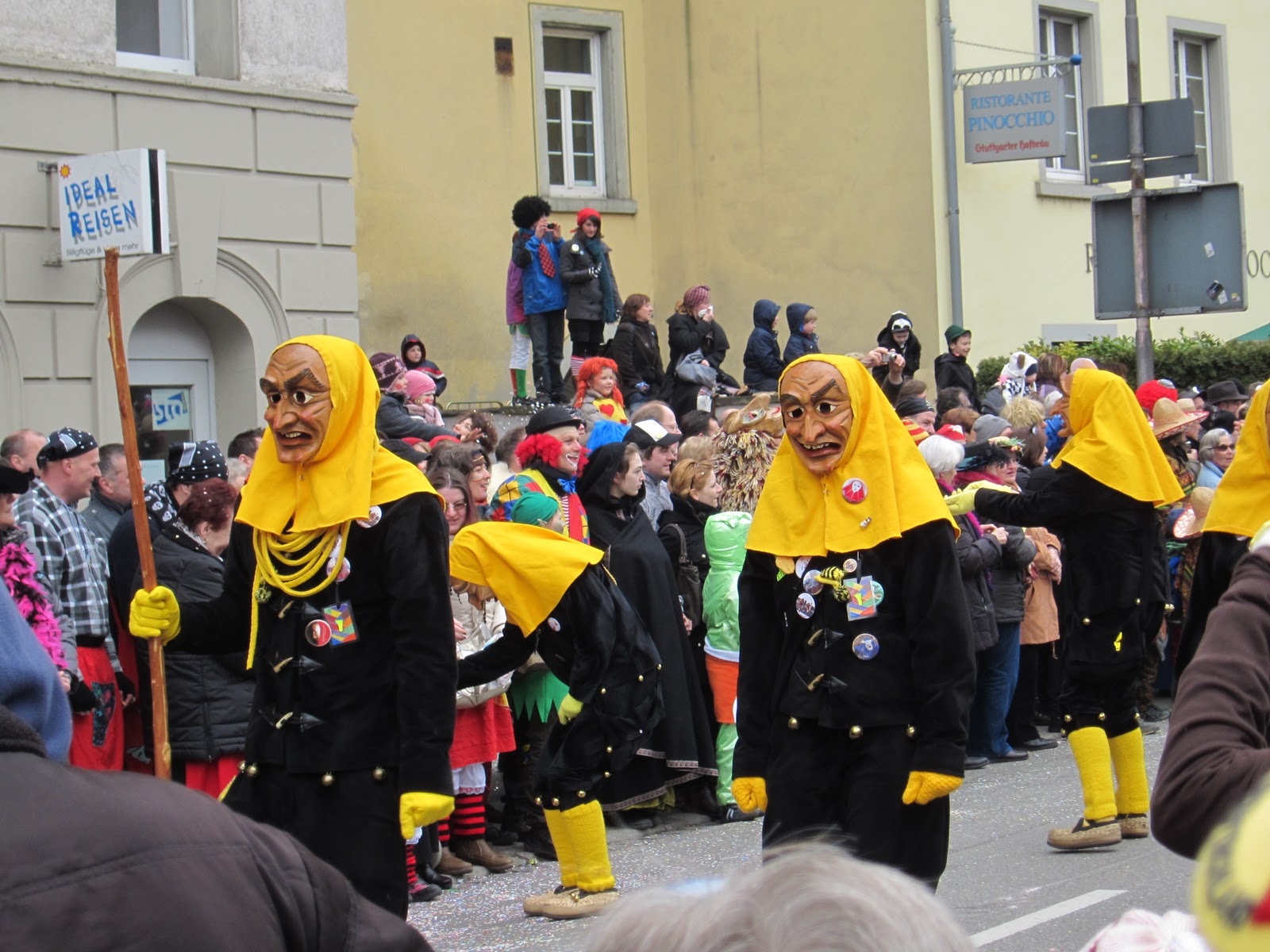
"Gelbfuessler" - Yellow Feet
One of the newer, Predator inspired Zunft
New group, old style.
Lots of groups make their costumes entirely themselves
  
Parodies of existing uniforms or characters are common

Montag, 7. März 2011

The Travelogue, Part V - England: Foodstuffs


Britain has not the best reputation as far as the quality of its cuisine is concerned. The culinary verdicts of the past decades has been that British food is bland, greasy and unimaginative. Extensive ramblings about the topic can be found throughout the internet. I do not want to add to them. Instead, I thought I'd talk about some of the foodstuffs that I particularly liked, and the ones I particularly hated. So here it goes:

Cider

Before England, I was a beer man. Probably what growing up in Germany does to you. Now, I am a man of cider. I honestly don't know why the stuff isn't popular in central Europe, as it's easier and tastier than beer, and gets you plastered much quicker. The variety of ciders in England is stunning. Some supermarkets have whole aisles reserved for it, and it comes in all sorts of types: dry or sweet, flat or bubbly, cloudy or clear. 
I recommend the one to the left, Weston's Vitage, which stands out as a pretty good supermarket cider and its staggering 8.2% of alcohol make sure you have a lovely evening. Steer clear of Strongbow, that stuff is just awful.


Cheddar

Among the otherworldly goodness that is cheese, among all the hundreds of varieties, you find kings and queens. Cheddar cheese is such a king. The only English cheese that made it to international renown, Cheddar, like cider, is ubiquitous in England's supermarkets. And just like cider, it comes in hundreds of varieties, from bland pizza-quality shreds to crumbly explosions of tanginess. As the national cheese of England it is laden with tradition, and its marketed with associations of abbeys, castles and good old English farmland (like cider).
Cheddar shines when it's mature, and I personally would advise you to skip the younger generations and go straight for the good stuff. Collier's is pretty good, but local farmer's market stuff is even better. You wouldn't have guessed it, but cheddar goes well with cider.

Pasty

Originally from Cornwall, the pasty is an oversized stuffed dough parcel. Allegedly it was used by miners, who would hold it by the crust and throw it away after eating (because of their dirty hands). The pasty has established itself as a traditionally English version of street food, and several chains can be found all across the island. The dough is a rich and sturdy shortcrust pastry, making pasties an excellent filler and easy to eat while walking. The traditional filling is steak, potato and onions, but contents have diversified into all the common tastes of modern society, including vegetarian and halal options. To be considered an authentic pasty, its contents must not be cooked before being enveloped.
I haven't had the chance to try these home made, but the chain ones are good enough once in a while, and tastes between them are pretty much the same. Go and try one if you fancy a quick meal on the go.

Pickles
 
When looking at the sheer amount of conserve varieties in England, one might think that pickling is a national past time. If you want proof of the English talent to incorporate foreign cultures into their own, and indeed the history of the Empire, look no further. It's right here, in the pickle aisle. From venerable pickled onions and gherkins, over the spicy mango chutneys of India to Carribean sauces and back to classic Piccalilly and Branston, Britain's colonial past can be experienced jar by jar in the safety of your own home.
I've tried many different varieties, and found the all to be quite delectable. It may suprise you, but many pickles go well with Cheddar (and thusly with cider). If you want all the good stuff in one go, order a Ploughman's lunch, which contains cider, cheddar and pickles at the same time. Hooray!

Marmite

Most animals, including humans, are equipped with a certain sense of what should be eaten and what shouldn't. We find all things repulsive that remind us of potential dangers to our health, such as the smell of rotten meat or faeces. Yet some people, whether by conditioning or sensory numbness, lack these vital perception capabilities. For those people, there is Marmite.
A yeast extract spread (i.e. fermented, gone off microscopic lifeforms), it smells of concentrated human exhaust fumes, and its taste is reminiscent of sweaty feet after a week of mountain hiking. It is marketed with the self-ironic slogan of “Love it or hate it”, but the fact that you have to wilfully exclude a majority of the population in a marketing campaign usually shows you're not selling a desirable product. The fact that it was created as a by-product of brewery waste, and needed a time of deprivation and scarce food supply (meaning World War II) to take off as a product doesn't really help its reputation either.
I strongly recommend to try it though, if you manage to get past the smell, as it is the culinary equivalent of visiting the London Dungeon and might give you something to talk about when you're back home.

English Bread and Cake

You might argue that it is somewhat unfair to expect the English to make good bread, when it is quite clear that they have no idea what bread actually is. I will then make an effort to explain: bread is a grain product, baked carefully to have a firm outside and a soft yet chewy inside. Depending on its type (yes, there are several), the outside can be crunchy, or even glazed with lye. By no means is it a fluffy, formless block without consistency or discernible taste. Bread also does not shrivel in your mouth to become a baking yeast chewing gum that dissolves under your tongue. Unlike spiders, humans can chew and have no need to dissolve their food externally.
Now you tell me that real bread can be had in England, in many varieties. I must unfortunately tell you though, that even at the farmers market or at the delicatessen stores, the bread suffers from the same problem, whether they call it “french bread”, “pita” or “naan”: it's too soft, lacks taste and is of poor quality. If you want any of these foreign breads, go to a local foreign restaurant (and cross your fingers).
And then cake. Coming from the Blackforest Gateaux county, I might be a tad spoiled, but British cake suffers from the same problem as the bread. Since we have already established the dough problem above, let's instead talk about icing. It is called icing (or frosting) because it is a layer of something on top of something else much larger. If there is more icing than anything else in your cake, you got the ratio wrong. Following the motto: "the more the better", you will sometimes have trouble finding anything left to eat after you dug yourself through an arm's length of molten sugar. There is no icing in between layers of dough either, that is called filling and is something else entirely. There is actually more taste to cake than sugar with a hint of something else. If you get the dough right, that is....
If you feel you have had enough of Disney-coloured icing in cups or cardboard bread, and you don't feel like oriental bread, head to Aldgate, where you will find a nice German bakery.

Jellied Eel

Oh the joy! Having likened Marmite to a culinary London Dungeon, this must be the Marquis de Sade's personal bedchamber snack. Pickled eel in itself is already not necessarily an inspiring taste experience, but in jelly, with chili vinegar, it has redefined my idea of what bad food can be. The flavour is somewhere between cold washing up water and lemon juice gone off. And the texture, oh the texture! Let it wobble in you mouth. Feel how bits of preserved eel dissolve from the bone unto your jelly-covered lips. Enjoy the unique feeling of having your oral cavity lined with chilli-spiced slime. Not even the accompanying potato mash can erase the severe taste bud trauma you have subjected yourself to.
I suggest a glass of Thames water to go with this dish. After all, if it's good enough for the eels, it's good enough for you.
The best jellied eel is to be found in Cockney, I am told. At least the slang there might be a welcome diversion from the harrowing seafood ordeal you just went through.

All this aside, the British seem to have become extremely sensitive about food (maybe due to the stereotype), and good food can be had in many (gastro)pubs and “modern british” restaurants. Columns about improving food and cooking qualities are all over the papers and websites. Local food companies (e.g. for chocolate) spring up everywhere. To me it felt, that Britain, just like Germany is an “awakening” food country, tired to be measured by the same clichés that soiled its national cooking reputation, and more than ready to show the world is has got imaginative cuisine and high quality food products of its own. I wish them all the best.*

*Scots are exempt from this. I mean, deep fried pizza? Seriously?

Samstag, 5. März 2011

The Travelogue, Part IV - England: Paranoia and Control


Open any British tabloid on any given day of a week, and I promise you, you'll find at least one stabbing. It might be taken from any random place in England, but it will be there, to get the damn thing into the hands of the customers. England does not have a particularly high homicide rate (not even London for its size), yet a lot of people seem to be under the impression that life becomes dangerous once you leave the door. Whether that is caused by the media or the media just reflects the national consciuosness I don't know, but this fear has generated a penchant for law and order that sometimes borders obsession. England has the most security cameras per person in the world, roughly estimated at one for every twelve inhabitants. The intensity of paranoia is apparent on every corner: “If you see something suspicious, report it immediately!” - “Smile, you are on CCTV!” - “You are being recorded for your personal safety and security.” are just a few of the recurring slogans. Convincing studies have found that increased CCTV coverage does not prevent crime or significantly improves chances of catching the delinquent, but that has not caused a decline of CCTV sales to both the goverment and private owners. I have never seen adverts for security systems and cameras on German television, yet in Britain, you see them frequently even during prime time. 

Adding to that, minor nuisances normally ignored or dealt with on a interpersonal level are elevated to be “half crimes”, so called ASBOs. ASBO stands for Anti Social Behaviour Order, and is issued for things that in other countries would be something for neighbours or parents to sort out: being too noisy, spitting on the floor or breakdancing in a public place (I kid you not). Since a lot of these small offences generally seem to be committed by people of lower social strata, ASBO has become a common English slang term for people of lower class and education, further labelling an already disadvantaged part of the population. Whether it actually helps reduce more serious crime (like the Broken Widows Theory is claimed to have done in New York), I cannot say, but it surely gave me the impression that Britain is a bit of a “Nanny State” as some people here put it. Its reach extends well beyond the jurisdictional and into the educational. No day passes where you don't come across and advert for a government campaign of some sort: Don't listen to loud music, don't eat smelly food, don't bunk off, don't insult our staff. 
But Mama Britannia does not stop here. After all, you could not only hurt others, but also yourself. So welcome to the wonderful world of

Health and Safety!

Have friends who recently became parents? Noticed how there is suddenly a whole world of dangers you never knew even existed? How everyday items suddenly require all sorts of special treatment before they can be used? How the very air and grass is a minefield of life-threatening perils? Have you been explained how constant watch must be kept on diet, surroundings and experiences of the little adult-to-be? It reminds me a lot of how the British government (and its associated organisations) seems to view its citizens.

Stories about about the overzealousness of public safety officials and idiotic waivers are usually associated with America, but Britain makes a fair second place. Again, government campaigns taking a dubious lead in the advertisement of common sense. I understand that telling young girls to not take Ibuprofen with Vodka (so they don't mind the cold when standing outside in short skirts in freezing winter) is important. Telling me to make sure I watch out for my friends so they don't get hit by cars on the other hand should be a given. If they do die, it surely was not my lack of awareness that unexpected contact with a driving vehicle can be fatal, but rather to circumstance, such a drunkenness or lack of oversight, which is not curable by public awareness campaigns. The same goes for coffee: if I buy one, I expect it to be hot. And if I spill it and burn myself, it will not be because of my inability to understand its thermophysical properties, but because I'm a clumsy idiot. Doesn't keep them from labelling the coffee cup lids, though.
To not have their asses sued off, private people have to resort to these warnings as well. Going to a martial arts class I had to sign a waiver that I am aware that I might get hurt. Well, duh.
Yet friendly regulation of my habits continues one more step up the psychological ladder; not only warning, but subtle conditioning. Every bottle lists for me how many units of alcohol it contains, and how many I should be consuming. Apart from being a relatively arbitrary value, I doubt that the people who this is aimed at, meaning alcoholics and binge-drinking students, care even the slightest bit. Sweets tell me they should be “enjoyed as part of a healthy and varied diet” and everything that contains even the most remote bit of greenery tells me it's one of my “five a day” (of fruit and vegetables). I am regularly told that “even a short walk is exercise.” and that I shouldn't let “good times turn bad (by drinking too much).”
All of this is apparently justified by the horrible state Britain's people are in. If I believe the public administration of this country, I've gotten myself into a whirlpool of rude obese drunkards, careless pregnant teenage tarts and criminal child molesters. Now either all these people must live in Wales, or I have been exceptionally lucky to meet mostly nice and responsible people. Maybe they are all secretly having an extra unit of alcohol and only four and a half veg a day on their couch, when no one's looking.

Dienstag, 1. März 2011

The Travelogue, Part III - England: Social Culture


Socializing

The best thing about England are undoubtedly the English themselves. Living in a country with an average of 110 rainy days a year seems to have bred people with a good sense of humour (or maybe the ones that are born without it simply kill themselves). The social culture is also quite different from Germany, and this bit is about some of its many pitfalls and highlights.

Masters of the Chat


You will often hear that the English consider themselves to be very reserved people. I don't know what the hell they are talking about. Maybe they compare themselves to Brazilians, who knows. Compared to northern and central Europeans, the English are extremely accessible people, and making new friends is amazingly easy. Here, people start chats with you all the time; the shopping queue, the pub, any public space really.
Germans, for comparison, have a rather large social distance. Random People talking to them for a prolonged time makes most of them somewhat uneasy. Many Germans I know over here have had this awkward moment of uncomfortable paralysis when they were first spoken to by a random friendly stranger. But once you are used to it, it's great. Mainly because Britons manage to make even conversations about weather somewhat entertaining.
The very language habits seem to make for a more friendly social culture. There is no polite pronouns, like in many other languages, so everyone is “you”, which already breaks some boundaries. Throw in the obligatory “mate” (or even “sweetheart”) and you already feel like you're part of the crew. Even communication with public officials is dotted with “mate” or “son”, and people will even crack a joke or two.
I was never a big fan of small talk, but the English have turned it into a delicate art form, and I respect them highly for it.
I frequently hear that while people here are easy to talk to, they do not (unlike, allegedly, Germans) make good long term friends. I have made quite the opposite experience, and my Brits are equally “deep” and reliable as my Germans.

The Rule of the Sugar Coating


My first encounter with the subtle conversational differences was at my job, when gave feedback on a colleague's work, with the effect that he was disgruntled for several days. In England, again like in Japan, you do not criticise directly. Instead, you must adhere to what I call the Rule of the Sugar Coating:

"When confronted with an unpleasant situation or potentially causing any discomfort to a person, even if justified or minor, first talk about something unrelated and positive. Once you have established a suitable agreeable surrounding, bring the issue to the forefront by using the mildest language you can, phrased in such a way that no potential blame could fall on you to be considered rude."

Imagine you are not particularly pleased with something someone has done at work, and you want him to change that. In Germany, the conversation would go something like this:

“Hey. You know the asset you gave me is not up to specifications here, here and here. Can you please redo it?”
“Sure.”
Job done. No offence taken.

Now in England, it goes like this:
“Hey mate, how're you doing?”
“Not too bad, not too bad.”
“So, how was your weekend?”
“Nice, did X and did Y.”
“Cool. You know I really love those models you're making. They're really awesome.”
“Thanks, dude.”
“You know, there's just one little improvement, quite a minor thing, that would make my work with them a lot easier. Would you mind having a look into that? Only if you have time of course.”

After that you leave it to faith if your message came across. Maybe the English value politeness higher than efficiency. That would at least explain a lot about the state of the railway system.

Conversation Topics


For a country that claims to boast some of the world's finest universities, people are surprisingly averse to intellectual topics. More often than not I met people where conversation stops dead in its tracks when it's not about pop culture. Albeit an extreme, I have encountered many conversations akin to this real life example:

She: So, do you like the band?
Me: Yes, they're awesome.
She: The frontman looks a bit like this guy X from East Enders, doesn't he?
Me: Erm, dunno, never watched it. But I like the way he's going mental on stage.
She: Oh my God! You never watched East Enders?
Me: No, don't have a television, actually.
She: (looks at me with a blank expression) But...what do you do all day?

Being well educated seems to hold not too much value in Britain, your reputation as a fun person is much more important. While knowledge books and shows are reasonably popular, they are usually about interesting trivia you can talk about, rather than hard facts. Play a British version of Trivial pursuit, and you will notice the difference; the German version comes with the topics History, Music, Science, Geography, Art and Sport, whereas the British one offers you only one topic that isn't football, films and famous people. I figure it helps sell new editions as you have to update all the questions with the new celebrities.
Education seems mainly a means to an end, not a generally desirable acquisition, and is much more specialist, trying to get you into a job a soon as possible with as little fuss as possible.* Schools teach at a much lower level than in Germany, and from what my studying friends say, university in England is a piece of cake compared to France, Spain or Denmark. You can even get a bachelor's degree in tailoring or surf science.

*I'm not even saying that's a bad thing, it just leaves most of the responsibility on you to acquire some general knowledge.

Mittwoch, 23. Februar 2011

The Travelogue, Part II - England: Proud Eccentrics


National Value Eccentricity 
- or be anything but boring


"Eccentricity has always abounded when and where strength of character had abounded; and the amount of eccentricity in a society has generally been proportional to the amount of genius, mental vigour, and courage which it contained."
- John Stuart Mill

One thing I love about England is that it values being different. Being a freak is seen as a sign of having a rich and interesting personality. Whereas in Germany you'd better not stand out too much, over here a modicum of weirdness is almost required to be considered a normal person. This eccentricity will take various forms, from trendy Shoreditch hipsters and tacky hen night girls to trainspotters; everyone here seems to have their little perks they carry outward.
There's a whole set of famous eccentrics that are well loved and often referenced. Take the example of Jeremy Bentham, founding father of the philosophical school of Utilitarianism, who had his corpse preserved for display at the University College of London. For anniversary college council meetings he is marked in protocol as 'present, but not voting'. Or how about the 5th Duke of Portland, who disliked the company of other humans so much he created an 12 acre underground complex to live in – painted entirely in pink. For more recent specimen, scout for some Adam Ant, Russell Brand or John McCririck.
I also assure you that the most competitions of bizarre nature take place in Britain. Want examples?

How about Conkers Championships


 Chap Olympics?


Or maybe the Gurning Competition?


If you now find yourself wanting explanation for all this, I have heard many theories about why the English are just more weird than other peoples. One of my (British) friends argues that because the English are not particularly good looking, they have to carry their personalities outward just a notch more. My french flatmate argued it stems from the the persistent reluctance to get invaded by culturally superior people. An article I once read suggested that Britain's rapid colonisation of the world and ensuing influx of money and cultural multitude allowed the British gentry to be carefree and extravagant.

I'd personally like to think that it's not its territorial expansion as an Empire, but simply this acceptance (or even encouragement) of quirky characters that has made British music, fashion, art and humour world famous.

Samstag, 19. Februar 2011

The Travelogue, Part I - England: Tradition Trumps Practicality


My travelogue begins with...England. Yes. England. After all, it's a foreign country, and its peculiarities are not less interesting than those of Thailand or Iran. Having lived her for almost three years, I have had quite a broad range of experiences, from cider with BNP supporters on the train to wine with a British lord on his estate, and I thought some of these experiences and observations I have made might be worth sharing for education and entertainment. 
If you feel like I'm treating your country unfairly, or you find some of the information inaccurate, remember that it is only a subjective point of view, a collection of personal experiences, and little more.

Tradition Trumps Practicality


Anyone who has been to Japan will probably agree on this; people who live on islands are weird. The size of the island seems to matter little in this aspect, and separation from the main landmass seems to foster and preserve all kinds of eccentric behaviours and traditions. Like Japan does in Asia, England perceives itself to be culturally separate from the mainland, and many British will strongly reject the notion that they are Europeans. This comes with a silent assumption that non-locals will never truly grasp oder understand Britishness. Sometimes it goes as far as inhabitants helpfully explaining British humour to help your cultural integration.
I cannot deny, however, that some aspects of British culture do elude my grasp. One of these aspects is its reluctancy to abolish overcome traditions.
Generally, England has struck me as a place where patina still has some value. The Queen's Guard, Beef Eaters, Bobbies; all of the styles of the past are kept alive somehow. Even my staunchest British technophiles love their pubs of brass and wood and their rows of Victorian townhouses. Some, like my landlord, would not even part with separate hot and cold water taps for a modern mixer tap, or would think of installing a modern, easy to use window handle. Every flat I lived in had a different, utterly impractical way of opening and closing windows, which was reinstated in the same awkward manner when broken.
England is also surprisingly anachronistic administratively, to the point where I have come to believe that the English must love the quaintness of the system just as much as the masses of tourists that come each year to marvel at the remnants of its products.
For one, there are the leftovers of feudal times gone long past. No, I'm not talking about the Queen (she's actually a extremely valuable PR asset), but the system of leaseholds, which is essentially a beefed up version of medieval vassalage: unless you are a freeholder (usually equals lord), all land belongs to the crown, and you will only ever be able to hold a temporary tenancy on the ground (and what you build on it!). While these tenancies are usually generously scaled (a thousand years in some cases), it still means that Crown Estate is one of the largest landholders in Britain, owning 55 % of its coastline and large urban porperties. Becoming a freeholder is possible, yet difficult, and until then you are just another serf to till the land.
Then there is the House of Lords, while subject to tentative reform over the years, is still pretty much a gentlemen's club lobbying for the status quo of the British upper class. Only recently the amount of hereditary members was reduced to 90, which is only some hundred years since the abolition of inheritance of political positions in the rest of Europe. As an added cherry on this medieval cake, the Church of England provides twenty-six permanent members to the House, the Lords Spiritual, making Britain the only (officially) non-secularized nation in Europe.
Or how about common law? Devised in the middle ages (when it probably made more sense), common law essentially means that jurisdiction in a trial must be based on previous similar cases. That gives you about 800 years of British legislative history to choose from. For example, the Magna Carta, drafted in 1215, is still a partially valid legal document in modern England. Many old laws, some of them rather obscure, have also not been abolished. In theory, for example, every Englishman would have to practice two hours of shooting the longbow each Sunday as decreed by the Archery Law of 1363. If you happen to be in York, any Scotsman with a bow and arrow is stil fair game after sundown and can be shot down. It is also officially illegal to die in the house of parliament. Go figure.
The adoption of the metric system has been riddled with similar oddities. After being met with strong resistance, it has been compulsory since 1965, some 20 years after the majority of countries had adopted it. Even then, it was met with staunch conservative resistance. Some of the arguments brought to bear were “people (on the continent) have on their desks calculating machines while we in Britain do the same sums in our heads." or that “...the kilo is too heavy for the housewife to carry. Still today, the use of imperial measurements is far from in decline. Like so many other local quirks it has instead risen to further prominence to form an integral part of national identity and woe befall any who even dares mention any length or weight in metrics. In the case of one Austrian pub, serving their draught in German steins almost cost them their license, as beer, among others, is an exception from the metric law and must be served in pints.
I know that by even writing about this I have already upset a few of my friends to the point where I will get a stern lecture on the time-honoured superiority of the foot, the stone and the pint next time I meet them.


Mittwoch, 16. Februar 2011

My List of Ten Things to do while still in England - No. 8 - Posh Afternoon Tea


Thank you Miss Muckett and Lindsay for organizing this splendid display of tea and treats.

Still on the list are:

- Shooting clay pidgeons with an English lord (thankfully I have one)
- Learning an obscure English accent (Cockney, likely)